How to Choose the Right Power Trowel Blades: Float, Combination or Finish?
Sep 01 , 2026
Choosing the right power trowel blade is an important part of achieving a smooth and consistent concrete finish.
Different blades are designed for different stages of concrete finishing. The three most common options are float blades, combination blades and finish blades. Understanding when to use each one can help improve finishing quality and jobsite efficiency.
1. Float Blades – For Early-Stage Floating
Float blades are designed for the early stage of concrete finishing, while the concrete is still relatively fresh.
They are generally operated flat or at a very low pitch. Their purpose is to help level minor surface irregularities, embed larger aggregate and bring mortar toward the surface, preparing the slab for subsequent finishing.
Best for: Early-stage floating and initial surface preparation.
For larger slabs, float pans are also commonly used. Their larger contact area allows the power trowel to work on relatively fresh concrete while creating a more uniform surface before finishing begins.
2. Combination Blades – One Blade for Floating and Finishing
Combination blades are designed to perform both floating and finishing operations.
When operated relatively flat, they can be used for floating. As the concrete becomes firmer, the blade pitch can be increased for finishing.
This makes combination blades a practical option for contractors who want to reduce blade changes during a project.
Best for: General-purpose concrete finishing where both floating and finishing are required.
3. Finish Blades – For the Final Surface
Finish blades are used after the concrete has become sufficiently firm.
As the concrete continues to harden, the blade pitch can be gradually increased through subsequent passes. This helps close, smooth and refine the surface to achieve the desired final finish.
Best for: Final finishing after the floating stage has been completed.
Float, Combination or Finish: Which Should You Choose?
Blade Type When to Use Main Purpose
Float Blade / Float Pan Early stage Floating and initial leveling
Combination Blade Early to later stages Floating + finishing
Finish Blade Later stage Final smoothing and finishing
A simple way to remember it is:
Float → Prepare the surface
Combination → Float and finish
Finish → Create the final surface
But blade selection is only one part of the process. The size of the slab, concrete condition, required finish and power trowel should also be considered.
Match the Blade with the Right Power Trowel
For smaller and medium-sized concrete floors where maneuverability is important, a more compact ride-on trowel can make finishing easier.
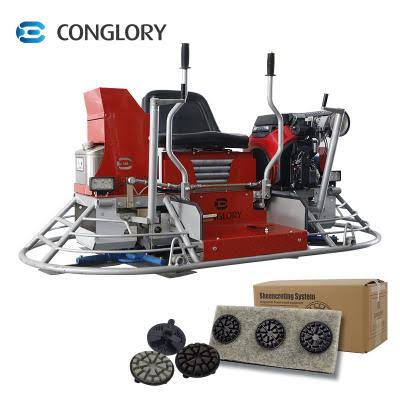
The CONGLORY CRP-1580 Ride-On Power Trowel provides a 1580 mm working width in a relatively lightweight 230 kg design. It is designed for efficient smoothing and finishing of residential, commercial and light industrial concrete floors.
Explore the CONGLORY CRP-1580
For larger concrete slabs, productivity becomes increasingly important. The CONGLORY CRP-1950 Ride-On Power Trowel offers a 1950 mm working diameter and 160 rpm blade speed, making it suitable for efficient smoothing and finishing of larger concrete surfaces.
Explore the CONGLORY CRP-1950
For heavier-duty and larger-area applications, CONGLORY also offers the CRP-2390H, featuring a 2390 mm working width, 26 kW/35 HP engine and hydraulic steering.
Choosing the Right Setup
There is no single blade or machine setup that is right for every concrete floor.
For early floating, choose float blades or float pans. For greater versatility, use combination blades. When the slab is ready for final finishing, switch to finish blades.
Then match the blade setup with a power trowel suited to the size and requirements of the project.
CONGLORY offers ride-on power trowels for different concrete finishing applications, from more maneuverable machines for small and medium areas to high-productivity solutions for larger slabs.




 IPv6 network supported